

2D edge-seeded heteroepitaxy of ultrathin high-κ dielectric CaNb2O6 for 2D field-effect transistors
Xiulian Fan, Jiali Yi, Bin Deng, Cong Zhou, Zejuan Zhang, Jia Yu, Weihan Li, Cheng Li, Guangcheng Wu, Xilong Zhou, Tulai Sun, Yihan Zhu, Jian Zhou, Juan Xia, Zenghui Wang, Keji Lai, Zheng Peng, Dong Li, Anlian Pan & Yu Zhou
Abstract
The experimental realization of single-crystalline high-κ dielectrics beyond two-dimensional (2D) layered materials is highly desirable for nanoscale field-effect transistors (FETs). However, the scalable synthesis of 2D nonlayered high-κ insulators is currently limited by uncontrolled isotropic three-dimensional growth, hampering the achievement of simultaneous high dielectric constants and low trap densities for small film thicknesses. Herein, we show a 2D edge-seeded heteroepitaxial strategy to synthesize ultrathin nonlayered 2D CaNb2O6 nanosheets by chemical vapor deposition, exhibiting high-crystalline quality, thickness-independent dielectric constant (~ 16) and breakdown field strength up to ~ 12 MV cm−1. The MoS2/CaNb2O6 FETs exhibit an on/off ratio of over ~ 107, a subthreshold swing down to 61 mV/dec and a negligible hysteresis. This work suggests a universal 2D edge-seeded heteroepitaxy and slow kinetic strategy for the scalable growth of 2D nonlayered dielectric and demonstrates 2D CaNb2O6 nanosheets as promising dielectrics for facilitating 2D electronic applications.
Summary of the paper
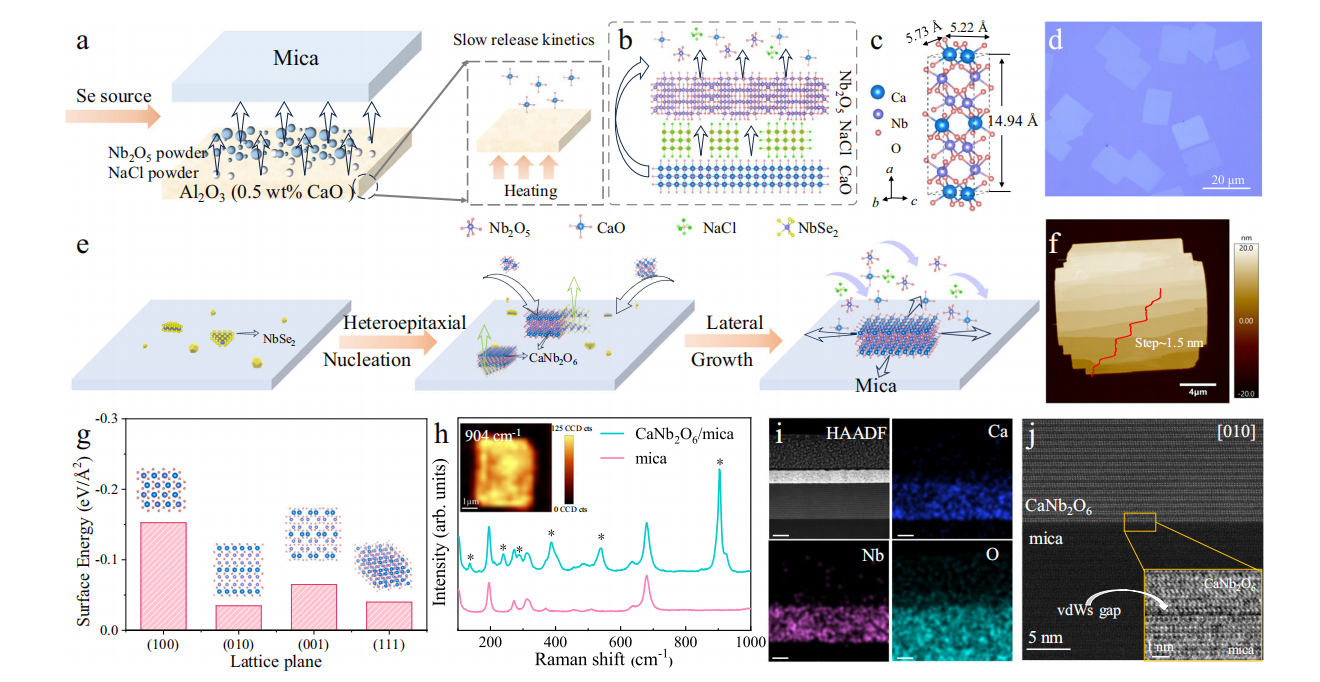
This paper reports a 2D edge-seeded heteroepitaxial strategy via chemical vapor deposition (CVD) to synthesize ultrathin, nonlayered single-crystalline CaNb2O6 nanosheets— a high-κ dielectric for 2D field-effect transistors (FETs).
Key findings include:
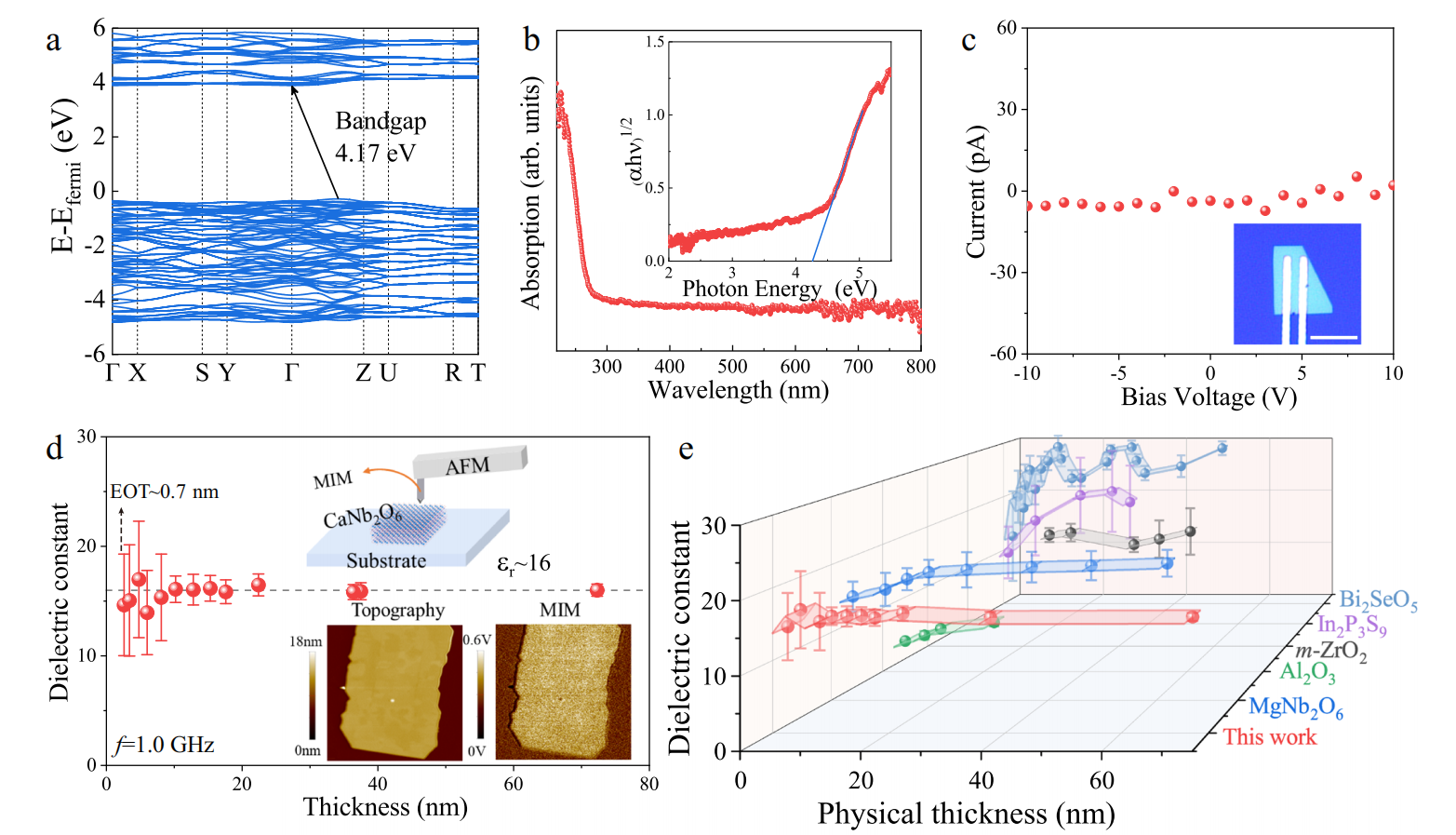
The CaNb2O6 nanosheets exhibit exceptional properties: thickness-independent dielectric constant (~16, down to 2.9 nm thickness/0.7 nm equivalent oxide thickness), large bandgap (4.26 eV), and high breakdown field strength (~12 MV cm⁻¹).
Air-plasma treatment reduces surface trap density, enabling MoS2/CaNb2O6 FETs with outstanding performance: on/off ratio over 10^7, subthreshold swing as low as 61 mV/dec, negligible hysteresis, and low leakage current (10−12 A).
This work provides a universal scalable method for 2D nonlayered dielectrics, highlighting CaNb2O6’s potential to advance 2D electronic applications.
在本篇文章中,扫描微波阻抗显微镜SMIM技术主要用于表征二维非层状 CaNb₂O₆纳米片(薄膜样品)的介电性能,是验证其作为高 κ 介电材料核心特性的关键手段之一,具体应用场景和作用如下:
- 厚度依赖性介电常数测量:研究团队利用SMIM技术,在1.0 GHz频率下,对生长于SiO₂和云母衬底上的不同厚度CaNb₂O₆纳米片进行介电常数校准与测量。通过拟合SMIM信号,他们发现 CaNb₂O₆纳米片的介电常数在2.9 nm(等效氧化层厚度 EOT=0.7 nm)至72 nm的厚度范围内保持稳定,约为16,未出现因厚度减小导致的介电性能退化。这一结果直接证明了CaNb₂O₆纳米片的 “厚度无关介电常数” 特性,为其在超大规模2D场效应晶体管(FET)中的应用奠定了关键基础,因为该特性可满足晶体管微型化过程中对介电层稳定性的严格要求。
- 介电性能空间均匀性验证:SMIM技术还用于评估CaNb₂O₆纳米片介电性能的空间分布均匀性。实验中,SMIM图像呈现出均匀的对比度,表明纳米片整体区域的介电常数无明显波动,进一步证实了通过 “二维边缘诱导异质外延 + 慢动力学生长” 策略合成的CaNb₂O₆纳米片具有高结晶质量和优异的结构均一性,而这种均匀性是保证2D FET器件性能一致性的重要前提。
- 辅助介电性能对比分析结合SMIM测得的介电常数数据,研究团队将CaNb₂O₆与其他已报道的 2D介电材料(如 HfO₂、ZrO₂、h-BN 等)进行性能对比,明确了CaNb₂O₆在 “高介电常数 + 高击穿场强” 组合特性上的优势——其介电常数(~16)处于较高水平,且击穿场强(~12 MV cm⁻¹)显著优于多数对比材料,从而凸显了 CaNb₂O₆作为 2D FET 栅极介电材料的竞争力。
综上,SMIM技术在本文中并非仅作为常规表征手段,而是直接服务于“验证 CaNb₂O₆介电性能核心优势” 这一核心科学目标,在薄膜类样品测试中发挥了关键作用,为后续2D FET器件性能优化和应用潜力评估提供了关键的实验数据支撑。

